
Posted : 1 days ago by Amanda Danells-Bewley

Work-based learning: forging pathways between theory and practice in higher education
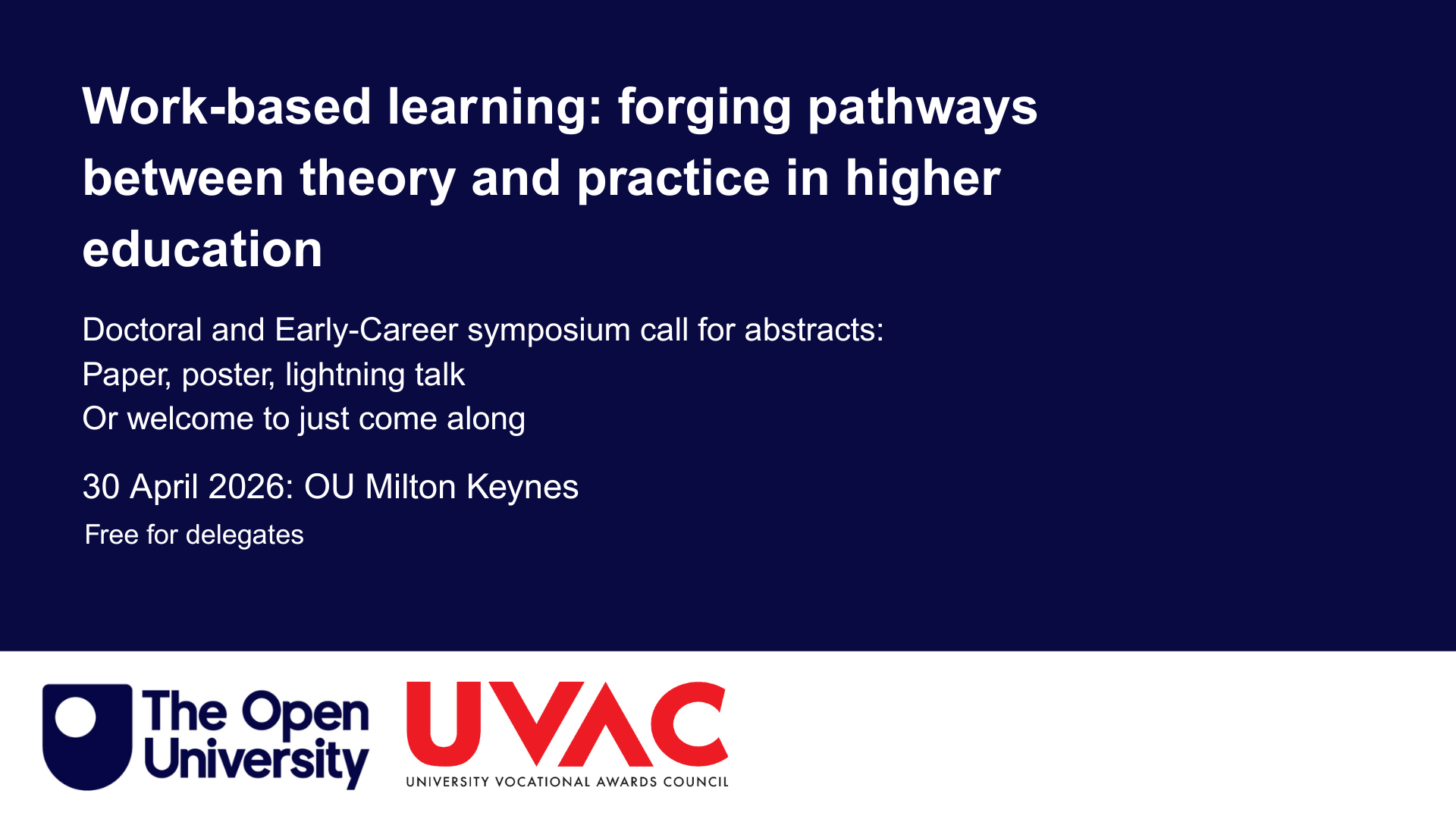
Work-based learning: forging pathways between theory and practice in higher education

This symposium, planned and hosted jointly by UVAC and The Open University, will take place in Milton Keynes on 30th April 2026. Taking the blending of theory and practice as our starting point, we invite perspectives on all aspects of work-based learning from the doctoral and early career researcher community. We aim to provide a safe and inclusive space for debate and dialogue in this exciting field, alongside a potential opportunity to develop your paper for publication through the conference hosts. 

We invite you to register interest in attending and/or presenting either a paper, poster or lightning talk via this  link by end of January 2026. 

  •       For a 15-minute presentation or lightning talk, please submit an abstract of up to 500 words via the link.  
  •       If you wish to submit a poster, please tick the appropriate box on the form. 

You are also very welcome just to attend.

Work-based learning, learning in the workplace, and ideas on lifelong learning are currently enjoying a renaissance. Advances in teaching, programme design and stakeholder involvement have generated significant public, organisational, and academic interest. This has been driven in part by a past decade that has seen substantial shifts in our working lives, and in how the organisations we inhabit choose to operate. Fresh perspectives and regenerated educational models are proving vital in unsettled global environments where post-pandemic technological and socio-economic accelerants jostle with political uncertainties and fragmented labour markets. 

Whilst educational and skills policies continue to promote personal development and growth, the search for skilled workers and national renewal are pushing the dial in favour of shifts to new and enhanced forms of learning and engagement around what employers and particular sectors need. This might be through new programmes of study such as degree apprenticeships, professional training or new forms of work experience and internship. Higher education partners are also embracing pedagogical initiatives: whether through newer digital delivery modes; wrestling with the opportunities and upheavals wrought by technological innovation; or enhanced interpretations of very old forms of learning, side by side with expert practitioners in the workplace. A variety of options are offered to learners – whether as work-based learning (defined  here as those in work going into higher education environments), work-informed learning (defined as those in higher education going into work – such as via placement schemes or work-experience schemes), but also internships and job-shadowing schemes. 

Amidst all these plans for change and innovation, and given the sheer scale of transformation possible, there is a pivotal role for academic inquiry and thoughtful scholarship. Work-based learning, by necessity, is a trans-disciplinary affair, where specific individual contexts for learning carry as much weight as classroom-based study and individual reflection. Whatever the discipline, problems and challenges of transmitting learning and developing competencies are just as relevant – this holds true from nursing to management, in policing and law, and in finance and engineering. What may have relevance in one sector (whether public or private) could offer new insights and new ways of working across typically unconnected sectors. Organisations ask not only what is worth learning today, but what we should be learning tomorrow. Policy makers ask how we should be learning and how higher education should be supporting their endeavours. 

It is at this critical moment that we look to our new generation of scholars, the growing community of PhD and early career researchers who are finding and charting our pathways forward, if not through a green-field site, then one that has undergone a period of under-theorisation and neglect until recently. 

The time has now come for the exploration and development of new ideas, but also the dusting off and re-tooling of stalwart concepts and applying them afresh to new workplace situations and modes of teaching, learning and assessment. 

Topics of interest might include (but are not limited to): 

  •       Papers focused on different stakeholder groups involved in work-based learning (learners themselves, coaches and managers, organisations, policy makers, higher education partners, compliance and quality bodies)
  •       Papers considering aspects of learner experience – e.g. complexity, constraint, success 
  •       Papers examining learning design, programme design and skills transfer 
  •       Studies on withdrawal and barriers to progression
  •       Studies that focus on work-based learning in conjunction with questions of equality and fairness, and social mobility and alternatives offered to young people and in other life stages
  •       Conceptual explorations of differences between work-based learning programmes, work-informed learning, and other developmental activities such as job-shadowing and work-experience
  •       Examinations of how different higher education institutions work with work-placement schemes and employability agendas 
  •       Reflections on own learning and professional practice 

This one-day event will take place on Thursday, 30 April 2026 at the Walton Hall campus of The Open University in Milton Keynes. For further information or informal conversation contact Dr Mandy Crawford-Lee (e) [email protected] or Dr Fran Myers (e) [email protected]