

New Innovation Exchange Announced: Inspiring Skills Excellence: Technology, Teaching and T-Shaped Learning
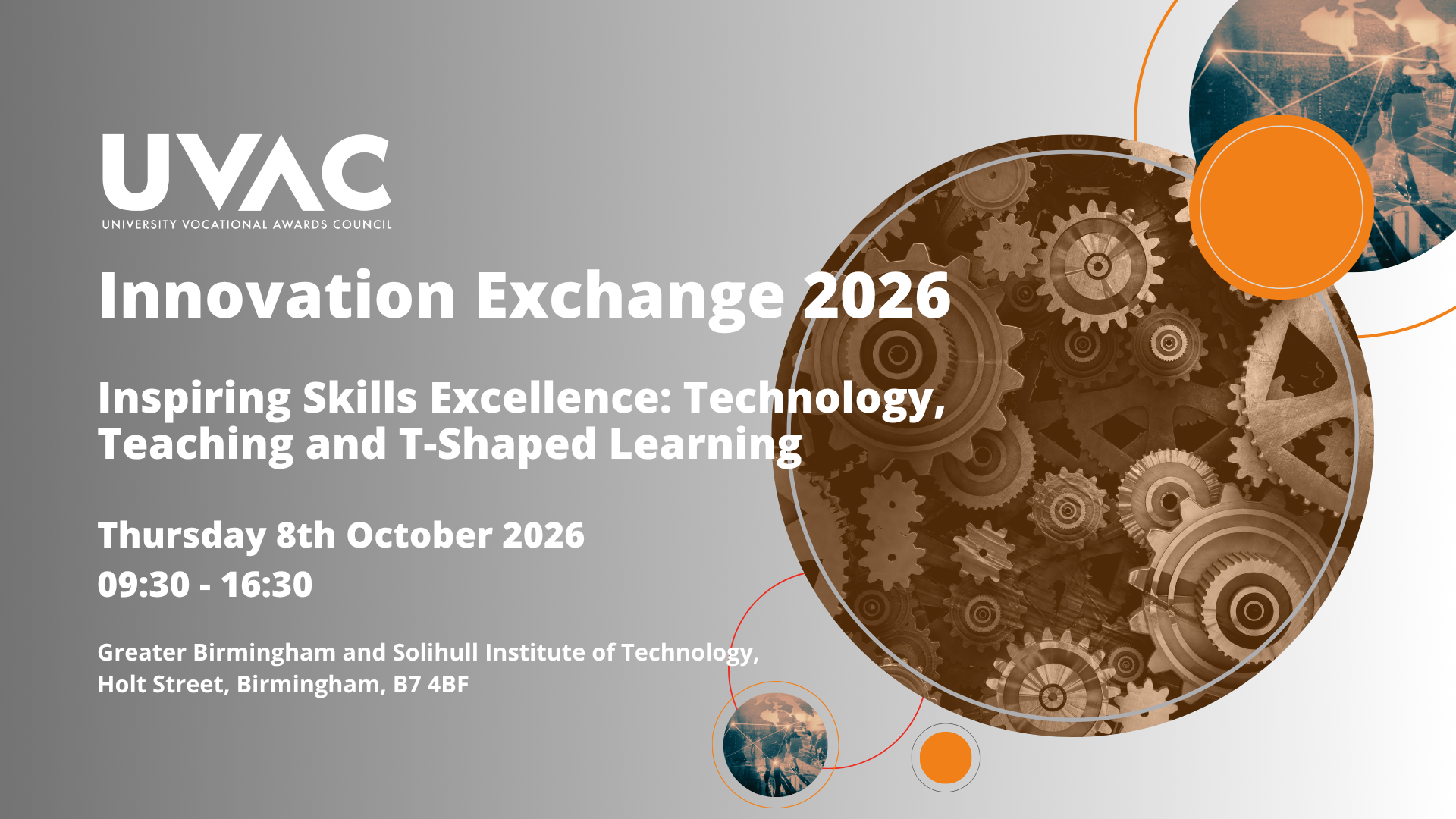
Join UVAC and leading voices from education, industry, research and the wider technical skills ecosystem for an inspiring Innovation Exchange, Thursday 8th October at Greater Birmingham and Solihull Institute of Technology Birmingham, exploring how advances in technology are transforming working practices, enriching learning experiences, and creating new opportunities to improve accessibility, inspire inclusion, and empower learners to succeed.
Bringing together colleagues from universities, colleges, further and higher technical education providers, employers, professional bodies, policy makers, and the wider skills community, this Innovation Exchange will explore how systems leadership can harness technology, strengthen teaching, and develop T-shaped learners—individuals with deep technical expertise, broad transferable skills and the adaptability needed to thrive in an AI-enabled world.
Together, we will explore how people, places, partnerships and possibilities can strengthen education and skills systems, build workforce capability and capacity, and share UK and international best practice to create a more inclusive, innovative, greener and fairer future.
As education and skills move firmly to the centre of national policy, there has never been a more important time to work collaboratively to create an integrated tertiary education system that provides equally valued academic and technical pathways, connected to meaningful careers and lifelong learning opportunities.
Whether a learner chooses a ‘hard hat or an academic cap’, success should depend on talent, aspiration and opportunity—not background, gender or geography. Whether through further and higher education, further and higher technical education, or apprenticeships, every learner should have access to the pathway that enables them to realise their ambitions and professional potential.
Why this matters
The UK faces significant workforce challenges. Engineering alone is projected to face a shortfall of up to one million people by 2030, while employers across priority growth sectors continue to report shortages of people with the technical, digital and AI capabilities needed for the future economy.
Engineering and technology occupations now account for 19% of all UK jobs—around 6.3 million people—yet diversity remains a significant challenge. Women make up just 17% of engineering and technology roles, compared with 56%across other occupations. People from UK minority ethnic backgrounds account for 15% of these roles, while disabled people represent 14%. A further 10% of employment within the engineering and technology sector is in wider business functions such as HR, finance and marketing rather than technical occupations. Although representation has improved, there is more to do, as evidence consistently demonstrates that more diverse workforces drive greater innovation, creativity and productivity.
At the same time, AI-powered technologies are becoming embedded across every industry sector and increasingly influence the way we work, learn and live. The need to equip learners and the existing workforce with the digital and AI capabilities required for work, learning and life has never been more urgent.
Digital confidence begins with strong digital literacy, yet significant gaps remain across the UK. Levels of Essential Digital Skills are influenced by factors including age, gender, educational attainment and income, risking the reinforcement of existing social, economic and regional inequalities as technology adoption accelerates.
The UK’s digital and AI skills shortage is estimated to cost the economy £63 billion every year. More than half of young people under 18, and almost one in four adults over 61, struggle with basic digital tasks, while 18–20% of UK adultslack the Essential Digital Skills needed for employment and everyday life, affecting everything from accessing online services and digital safety to participating fully in modern society.
Even among highly educated and higher-income groups, digital capability gaps persist, with around one in two academics and one in three higher earners unable to complete all essential digital tasks. Workforce productivity is also affected, with more than half of working-age adults unable to perform all 20 digital tasks considered essential for employment.
Closing these skills gaps could contribute more than £23 billion annually to the UK economy, improve workforce productivity, increase earnings and help address growing shortages of digital, data and AI talent. The challenge is clear—but so too is the opportunity.
Innovation in action
Addressing these challenges requires more than isolated initiatives. It demands systems leadership, stronger partnerships, and a shared commitment across education, industry and government to create coherent skills pathways that respond to the changing needs of learners, employers and the economy.
Throughout the exchange, colleagues will explore how universities, colleges, further and higher technical education providers, employers and other key stakeholders, can work together to widen participation, strengthen technical and professional pathways, and develop inclusive, future-focused talent pipelines.
Together, we will examine how technology can enrich teaching and learning, how digital and AI capabilities can be embedded throughout curricula, and how workforce capability can be strengthened to support lifelong learning, innovation and economic growth.
Recognising that these challenges extend well beyond the UK, the Innovation Exchange will also explore how international collaboration, and the sharing of effective practice, can strengthen education systems, improve workforce capability, and accelerate innovation across technical education in the UK and globally.
What to expect
- The Innovation Exchange will provide an opportunity to hear from inspiring keynote speakers from education, industry, research and policy, exploring the digital, AI and future skills needed for work, learning and life.
- Colleagues will gain practical insights and real-world examples of how innovative technologies are transforming teaching, learning and workforce development, alongside approaches for strengthening digital literacy and AI capability across all levels of education.
- The programme will offer forward-looking perspectives on emerging workforce trends, future skills priorities and international best practice, supporting organisations to anticipate and respond to the changing needs of employers and learners.
- Through evidence-informed discussion and shared experience, participants will explore approaches to strengthening quality, workforce capability and innovation across further and higher technical education through systems leadership and collaboration.
- The exchange will also provide valuable opportunities to connect with colleagues across education, industry and policy, share ideas, build partnerships, raise standards and champion future skills for all age, level, and sector learners.
Exclusive Learning Factory Site Tour
Experience the Learning Factory—home to Europe’s largest cyber-physical manufacturing rig dedicated to Industry 4.0 training.
During a guided tour with live demonstrations of cutting-edge industry-standard equipment, discover how emerging technologies are transforming manufacturing, reshaping work practices and creating exciting opportunities for technical education and workforce development.
Take part in interactive and immersive learning experiences that bring advanced manufacturing technologies to life and demonstrate how innovation can enhance teaching, learning and inclusion.
See first-hand how technology is helping to raise standards, inspire innovation, champion future skills and empower learners to achieve technical excellence.
Join the conversation
Be part of the conversation shaping the future of technical education—where systems leadership, innovation and collaboration unlock new opportunities for learners, employers, communities and the wider economy.
REGISTER for this event today!
Many Thanks to Innovation Exchange Partner
IN OTHER LATEST NEWS

5 days ago, Amanda Danells-Bewley
5 days ago, Amanda Danells-Bewley